
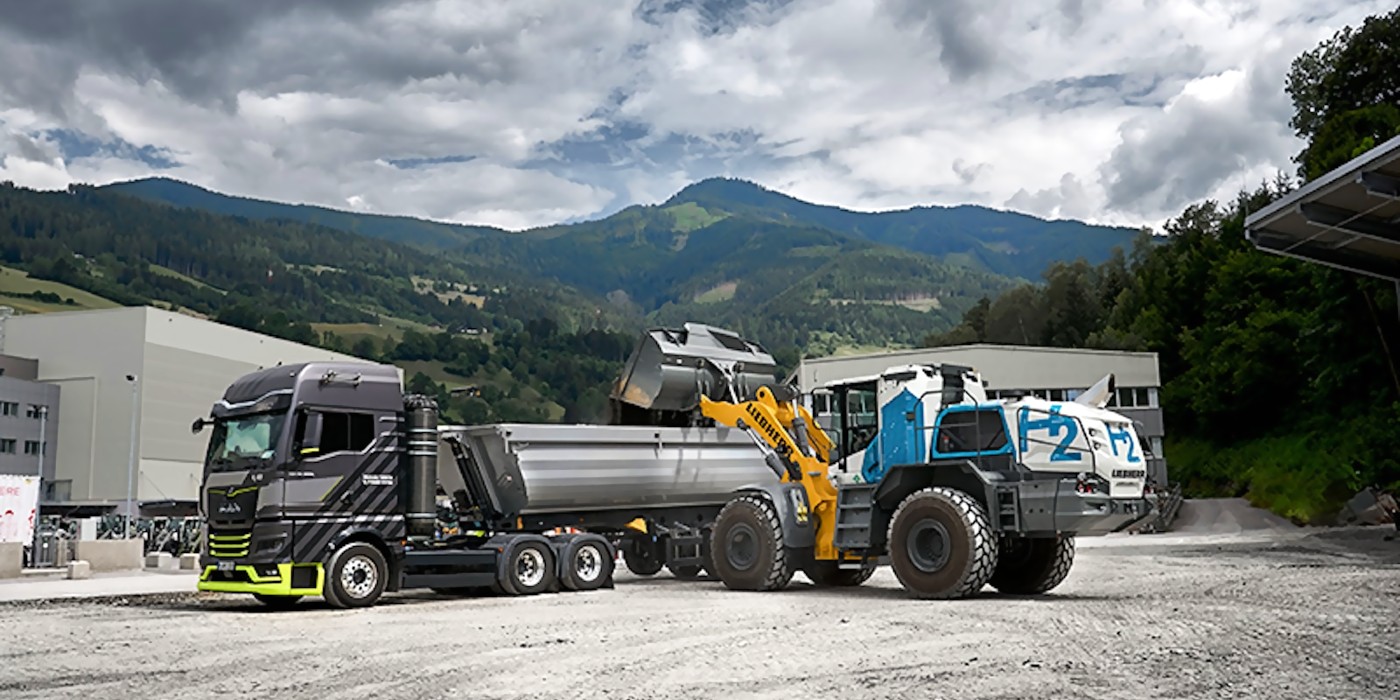
Construction and mining equipment giant Liebherr is calling its hydrogen-powered wheel loader the first of its kind in the world. Now, the company says its loader will be part of a pilot project at the Kanzelstein quarry in Gratkorn, Austria.
Shown for the first time earlier this year at Liebherr's private test site, the new project is intended to serve as a proof of concept pilot between Liebherr and STRABAG, a major Austrian construction company. STRABAG will use the L 566 H wheel loader prototype in a two-year test project.
To refresh your memory, the new Liebherr wheel loader is not powered by a fuel cell. Instead, it is powered by a specially modified combustion engine that burns hydrogen instead of diesel. The companies estimate that the engine will save 100 tons of carbon dioxide emissions every year, which is equivalent to about 37,500 liters of diesel.
“Technology … enables large vehicles that are difficult to electrify due to their high energy demand to operate without emitting carbon dioxide,” explained Dr.-Ing. Herbert Pfab, technical director of Liebherr.
The hydrogen filling station, provided by Energie Steiermark, will provide the raw hydrogen needed to fuel the wheel loader directly at the quarry.
Electrek's Take
Earlier this year, MAN Trucks CEO Alexander Vlaskamp told a Spanish magazine Expansion (translated from Spanish), “It is one thing to have the technology and another for the technology to work. Raw hydrogen is not available for transport and there is no reason to switch from diesel to hydrogen if the energy source is not sustainable.”
And that's a problem, since there are currently no benefits to reducing carbon emissions by using hydrogen as a fuel. This is because most of those 90 million tons are produced from natural gas and fossil fuels.
That's not just my take, either. That's what Mahle CEO Arnd Franz tells people.
“We cannot achieve any reduction in CO2 emissions if we use natural gas or other fossil sources to produce hydrogen,” Franz is quoted as saying. “Today, most of the world's hydrogen production is about 90 million tons. That number will rise to 130 million tons by 2030. Currently, we have a thriving and growing segment of that which is more sustainable. By more sustainable, I mean blue and, ultimately, green hydrogen. In our view, [blue hydrogen production is needed] to keep the infrastructure going so that the ecosystem can be found.”
So, where does that leave Liebherr and its STRABAG project? Do we see it as a genuine effort to advance (what they think is) a promising technology, or do we think it's a mindless cash grab for government hydrogen subsidies?
As if to answer that question, STRABAG CEO Klemens Haselsteiner said, “We want to be climate neutral by 2040 … the only way to achieve this is to continuously and completely save carbon, for example, in the operation of construction machinery.”
Scroll down to the comments and let us know who you believe.
SOURCE | PHOTOS: Liebherr, by Heavy Equipment Guide.
FTC: We use auto affiliate links to earn income. More.
