
It looks like a VW Bus at first glance, but what does it compete with? And will its allure last?
The 2025 Volkswagen ID.Buzz, the electric remake of VW's 1960s Microbus, is finally here. After a seven-year wait, the super-stylish 3-row box with wheels will be available in stores in November and December—most importantly going to those dealers that sell high numbers of the ID.4 compact electric crossover.
The Buzz retails for $61,500 to $71,500, with an EPA combined range of 234 miles in base rear-wheel drive form or 231 miles with optional 4Motion drive. North America gets the long-wheelbase version of the Buzz sold in Europe, with six or seven seats depending on trim—and, to answer a common question, we won't get a commercial panel-van version offered there. (See “chicken tax” for the reason why.)
A media drive in mid-October was held in the San Francisco Bay Area, which is home to more EVs per capita than any other part of the US save Los Angeles. The launch event began with more than a dozen Buzzes driving down Lombard Street in a famous group photo swap. Then we headed north, with photo spots under the Golden Gate Bridge, near the beach, and at various scenic spots in Marin County.


Photos by John Voelcker.
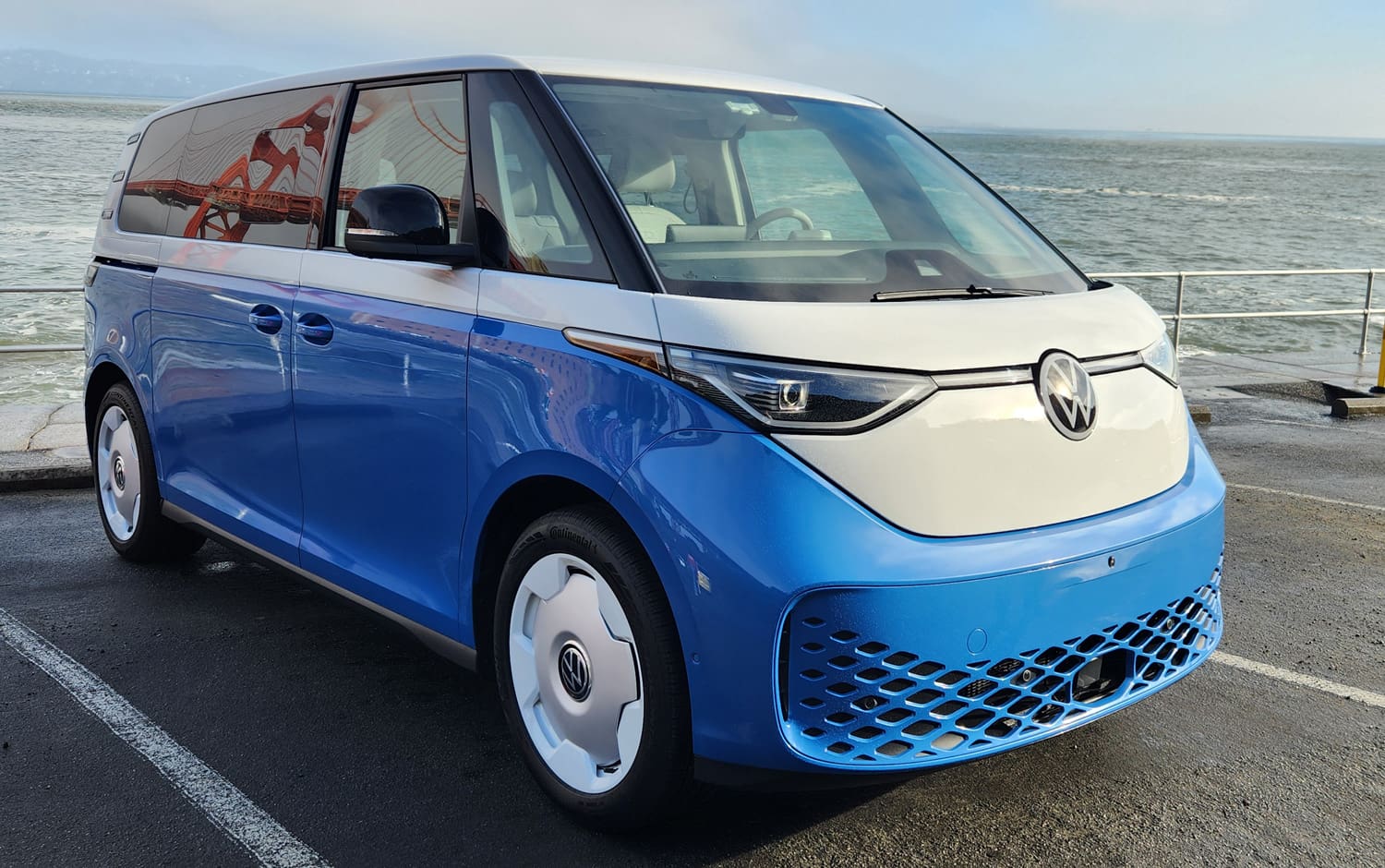
Iconic shape, two-tone
ID.Buzz still receives as many views, photos, and questions from onlookers as it did when production was announced in August 2017. Immediate recognition comes from the large, illuminated VW badge on the front, as well as the one of eight two-tone. painting works. All but one used a white upper body in addition to a choice of orange, yellow, green, blue, “charcoal green,” silver, or gray. To my eyes, the silver-over-Cherry Red combination is less successful. Three similar colors—black, white, and silver—round out the exterior offerings. Inside, North American buyers have a choice of three “color worlds” not offered in other interior markets: Bronze, Dune (ivory), or Moonlight (deep brown). Buzz does it not offering, as VW clearly pointed out, a black German interior. And be quick about that.
The Buzz is undeniably long, straight, and flat-sided. The short front nose and fixed window between the windshield pillar and the front of the door frame effectively hides the large distance between the base of the windshield and the driver + front passenger inside. That provides the kind of crushed safety zone that was missing from the original Type 2, which lasted several decades after its introduction in 1950 with the driver's feet just 18 inches or so from the crash.
Characteristic structural elements include very short overhangs, excellent outward visibility thanks to upright seats and multiple windows, a large interior volume for its printing, and rear-wheel drive. It is now powered by an electric motor, not a flat-4 combustion engine, but still.
The front and side views are attractive, but the vertical, knife-edge rear seems to me to be the least successful angle of the car. Still, it opens up 18.6 cubic feet of load space behind the third row, which expands to 75.5 cu ft when you remove the third row entirely—and a remarkable 145.5 cu ft with the second row folded flat (not removed).


Photos by John Voelcker.
Small turning circle, predictable performance
All versions of the ID.Buzz sold in the US are powered by a 91 kilowatt (total) battery. The standard model has a 210-kilowatt (282-horsepower) engine powering the rear wheels, rated at 413 lb-ft of torque. The 4Motion all-wheel drive system adds a 40-kW (53-hp) engine to power the fronts, rated at 99 lb-ft. The range of the two versions is remarkably close: 234 miles for the RWD, and just 3 miles less than the AWD variant at 231 miles.
Behind the wheel, our jaunt down Lombard Street quickly made it clear that even though this is a big car—it's the size of a VW Atlas Cross Sport midsize two-row SUV—its 37.4-foot turning circle makes it very manageable (42.7 feet for the model for 4Motion AWD). It's a shared symbol with the ID.4, and we commend VW for using the EV package to do it.
Acceleration is far from a Tesla-style kick in the small of your back, but the measured speed is an improvement on the original Microbus that shouldn't have put such a fine point on it—it's too slow, sometimes dangerous. Volkswagen quotes acceleration from 0 to 60 mph in about 6.0 seconds, though we can't do any testing with the instruments.
Regenerative braking is not very powerful, probably due to the power to weight ratio. We longed for one-pedal drive up to 0 mph, but it's not provided. The regen felt stronger in the AWD version, with its extra engine—though the steering also felt heavier in that model.
Handling and road holding are, by the way, unremarkable. It is predictable, reliable, and safe, although even on 20-inch wheels, you can feel the tires working hard to control the load of the 3-ton car when driven even at full speed. That probably won't matter for shopping or school transportation.
Various issues and problems with VW's user interface have been covered for a long time by other shops, so we will not describe them here. Two examples will suffice. First, some screens have back buttons—but others don't. Second, the vehicle icon on the 12.9-inch central display's header bar produces one set of settings—but the same icon on the main navigation screen produces an entirely different set of options. This is absurd.
Volkswagen's onboard Level 2 charger is rated at 11 kilowatts, assuming the charging station and circuit can provide it. DC fast charging is quoted up to 200 kilowatts; as usual, that is under the right circumstances. We weren't able to recharge the Buzz during our short time with test vehicles, but we look forward to doing so when we get one for a longer test.


Photos by Sam Dobbins, courtesy of Volkswagen of America, Inc.
Seven seats, great visibility
Shorter drivers may need to learn the best way to climb up and into the Buzz, which could use a lower step on the door sill—rather than the current beveled metal sill. The driver ends up using the steering wheel as a grab handle, and the actual grab handle above the door feels very flimsy under the weight of each of the two middle-aged male drivers.
Once inside, the leatherette seats are comfortable, the way forward looks great, and the entire cabin feels light and airy. That's thanks to the largest glass roof ever offered by VW, a standard feature with electrochromic “smart glass” that instantly changes from translucent to highly tinted at the push of a button.
The second row can be either a 3-seat bench or captain's chairs, but there's still plenty of room behind the sliding doors for easy access to the third row. Volkswagen says the ID.Buzz has the best third-row legroom of any vehicle sold in North America today. While we wouldn't compare it to the Chrysler Pacifica, Honda Odyssey, or Toyota Sienna, the third row felt as big as the capacious Pacifica, currently our gold standard for third rows.
For flexibility, the “Buzz Box” center console can be moved or removed completely. The Buzz still doesn't have as many useful storage spaces and cubbies as your average Hyundai. While there are cup holders on the console, for example, the door pockets don't have bottle holders molded into them, so a water bottle just slides out. On the other hand, most storage areas have rubber pads on the bottom to hold small, lightweight items in place.
In a first for any Volkswagen sold in North America, some versions of the ID.Buzz include a retractable trailer. Towing capacity is 2,600 lbs with standard all-wheel drive, and 3,500 lbs with AWD—and no doubt a real-world range-matching hit. Unfortunately, our pre-built test cars didn't include a hitch, so we can't measure how well it works.
What is it, and who wants it?
One of the biggest questions on ID.Buzz is what it's competing against. VW has stayed away from the term minivan, saying that only 3 percent of people who raise their hands at Buzz are van owners. The biggest numbers come from a midsize SUV (57 percent) or a full-size SUV (28 percent).
This led VW to put together a comparison slide featuring an array of truly remarkable vehicles: the Chevrolet Suburban, the Chrysler Pacifica (plug-in) Hybrid, the Kia EV9 (an EV), the Rivian R1S (an EV), the Toyota Sienna, and its VW Atlas. We may add Lucid Gravity in the future as well. The ID.Buzz is the shortest, but it has better headroom in the second and third rows, and more cargo volume: 1 cubic foot more than the big Chevy Suburban.
But will interest last? VW's experience with the two generations of the New Beetle has shown that retro designs tend to sell well at first, but fall quickly. Can the Buzz endure? Stay tuned.
Prices and features
The 2025 Volkswagen ID.Buzz range starts with the Pro S model at $61,545, which is only available in rear-wheel drive. Standard features include sliding side doors and tailgate, 12-way adjustable heated and ventilated front seats, heated front seats for two side exits, three-way climate control, no less than eight USB-C ports, -12-volt. an outlet in the cargo area, and a 120-volt socket in the front row.
Stepping up to the Pro S Plus adds another $2,500, if you trade in that retractable towbar, a head-up driver display, and the 4Motion AWD version, a heated windshield and second-row captain's chairs. the bench. Captain's chairs are a $695 option on the RWD Pro S version. Other options on all Pro S Plus versions include two-tone exterior paint ($995) and a panoramic glass roof ($1,495).
Finally, the limited Edition package adds another $2,000 on top of that, for a total of $67,045. The Pro S Plus features two-tone paint, a panoramic glass roof, and power doors, along with 20-inch wheels, Heritage floor mats, and special badges.
On the Pro S Plus and First Edition, 4Motion all-wheel drive adds a total of $4,500 to the price. All quoted prices include a mandatory $1,550 destination charge.
Volkswagen provided the airfare, lodging, and meals so that Charged could bring you this first-person driving report.